I've been noticing straw man fallacies in atheist circles lately. First it was the Starbucks plain red holiday cup, which was claimed to infuriate Christians but really didn't, and now it's the immigration issue.
While I support the use of fallacies as effective rhetoric, it smells bad when atheists make a racket over a non-issue. Sure, it brings the atheist community together, uniting us against "them", but it makes us into just as unthinking, emotionally-reactive demagogues as the preposterous straw man Christians we're supposedly miffed at. Surely we're better than that?
This reminds me of the controversy over the " something in the water" song. A friend of mine, who doesn't know I'm an atheist, was flabbergasted at atheists for being so petty to condemn a song. I had just read an article about how there wasn't any atheist reaction and told my friend that what she'd heard was a straw man argument. There was no controversy, yet I had to settle one. Surely a higher, cleaner level of discourse can be achieved.
But maybe not. Emotional arguments have always triumphed in religious and political debate. We're emotional animals first, rational minds second (if at all). This is why I no longer always frown on the manipulative use of rhetorical fallacies when my opinion is supported. This is politics and power, not truth-seeking. This is the will to power, fight dirty if it's effective (the end justify the dishonesty).
I wish it were a different world, one where honest discourse were rewarded, but it's not the heights of our reasonableness that is our average; it's the lower common denominator. Communication is manipulation, and truth is only as good as it is useful. Unfortunately straw men are useful, too.
But who do we want to be? Everyone wants to win fairly, but is a better world; one less ravaged by religion's lies, worth fighting dirty for? And if religious people use these same dirty tricks of rhetoric, does that excuse our sinking to their level? I'd like to think my side is the good side, the honest side, but could I be content with just being on the triumphant side? It smells too bad, it doesn't feel right; the morals I'm stuck with don't allow me to feel right about it.
But that's my problem. My idealized picture of the world doesn't match the one I exist in, and the morals I have don't serve me well. I'd be happier if my expectations matched my really.
Friday, November 27, 2015
Straw Men

Monday, November 4, 2013
Today is a friend's birthday. We had Lemon Cake, his favorite. I asked what wisdom he had on his 50th birthday to share with us. He said PAP: Perception, Adaption, Persistence. This makes sense.
Half of intelligence is perception - knowing what is in your environment. This is why it's so important to know how to think critically and not get drawn into faulty thinking about reality. we need to know reality and know how we're prone to misread it, especially if we intend to do anything with it.
Adaption is easy. I could get used to anything. No sweat, just making the best of things. Of course, bringing perception along is vital.
As to Persistence: this.
Half of intelligence is perception - knowing what is in your environment. This is why it's so important to know how to think critically and not get drawn into faulty thinking about reality. we need to know reality and know how we're prone to misread it, especially if we intend to do anything with it.
Adaption is easy. I could get used to anything. No sweat, just making the best of things. Of course, bringing perception along is vital.
As to Persistence: this.
Monday, July 1, 2013
Scale in perspective
A friend showed me a picture of the radius which radio waves have traveled to outside of earth in the past 70 years or so. It's a tiny dot in comparison to the size of the galaxy we live in, which the picture is of. He says that all our troubles, etc., are in that dot, and that we therefore don't matter. Drew sees his sphere of influence as tiny in the grand scheme of things, and he despairs.
This is the same despair created when we care too much about politics. We are too small to do anything big. Look at the greatest rulers in the past - all their accomplishments. This handful of world leaders and conquerors, all they've done, is hardly remembered or relevant. Genghis Khan may be the ancestor of millions of living people today, but he's still dead, and hardly any of his descendants know or care about their lineage.
Our sphere of influence is as big as we are, and only extends further so much as we can influence others. Unless we get something out of the extension of our influence, there's no reason to try. What could I want that I could get through influencing others? A family, a salary, friends, etc. What could I want from a galaxy?
Saturday, June 1, 2013
Musings on "The Black Swan"
Black Swan
an event which
(1) is a surprise,
(2) has a major effect, and
(3) is rationalized by hindsight.
There's a book.
Applying this type of thinking to my life is difficult for me, but I have a few ideas.
There are good black swans and bad ones.
A good one could be outrageous success as an entrepreneur. If I start a business, I could make it big. Considering the industry I'm in, however, this is unlikely. Horticulture has too low an entrance barrier; anyone can compete. However, is there an area in horticulture which has the possibility of being a good black swan? In plant breeding there's the possibility of finding a novel, patent-able, and profitable trait to sell. In every other horticultural pursuit it seems that results aren't scalable. Even if I land an exquisitely high-paying job, I still have to work for it. There's no black swan lottery winning in horticulture.
However, there are smaller surprising, majorly effective, rationalized events. There's the opportunity I had last year when a senior manager resigned and gave me his position on a silver platter.
A bad one would be a major injury. This would surprise me, have major effect on myself and my career, and I'd probably think it was bound to happen. This almost happened to me this spring, when a coworker dropped a limb on my head and gave me a light concussion. It could have been much worse, a negative black swan which would have destroyed me.
I need to seek good black swans, situations in which big gains are possible and not much damage can come from failure.
I need to avoid bad black swans, situations in which only a small or mediocre gain is possible, but a large loss is possible.
I need to avoid bad black swans, situations in which only a small or mediocre gain is possible, but a large loss is possible.
I need to invest 80-85% in stable, risk free investments and 15-20% in investments with good black swan possibilities. I need to not go for mediocrity, but for surety of return and possibility of great results.
What else does this strategy apply to? Spouses? Careers? Cars? Exercise? Diet?
There's so much to re-think.
Permaculture as a philosophical problem
Permaculture has a philosophical problem. If a permanent, easy lifestyle could be attained, would it be a happy one? Do we need the rat race to be happy? Has competition been bred into us?
Evolutionary psychology may have something to do with it. Why be happy with what you have? Isn't the notion that you're content an indicator that you could have more?
Think of Amish and Mennonite people. They live with less, and have an acceptable quality of life/level of happiness, all while away from the rat race. But, they live in a closed community, they don't see what they don't have, and they disdain what they don't have as immoral for them.
What about stable native cultures, like of Papua New Guinea? In "Collapse" by Jared Diamond, they're seen as happy and curious. Is this how a stable humanity would be? How can we be stable with so many different people, so many other sides of the fence where grass is greener? A large part of happiness might be the lack of envy found in the ignorance of a better life.
What does the average person do, anyway? They find stable employment they can do and stick with it. It's boring, yet a living. For most it's not even much of a living, just enough to keep them needing to come back for more.
Maybe I'm not cut out for chilling out. Maybe I see the other side of the fence too much. Maybe I need to cultivate the idea that my life is as good as it can be.
My coworker was telling me about his bug-out bag, his plan to buy a four-wheeler just for emergencies. Perhaps his desire for a meta-apocalyptic situation, like a zombie epidemic or gang war, is fantasized about because he wants the change in environment that it would bring. I've known many people like this. The change would rip them away from the stable employment they've been at these years, forcing them to change, to have adventures. None of us want the difficulties of violence and disruption, but we all want the adventure, the upheaval of our lives. Our lives aren't as interesting as those of the characters in zombie movies. They don't have the same carnality or lack of responsibility. This modern life is devoid of the carnal, everything is so clean and polite. It is non-dynamic, a-manual. We want the adventure, the movement, the killing of zombies who were our annoying suburbanite neighbors minutes before. My coworker's preparation of a "bugout" bag, his fantasizing of escape, is perhaps the result of this unconscious desire to radically change his life. To get rid of "the others"; those that enforce the molds we're in, to be free of the rat race created by other's competition, and to escape from the docile passivity of our lives.
But in my reality, in my yearning for adventure and escape, what can I do? Really, can one escape from general humanity, let alone their own? "If you can't beat them, join them" becomes confusing if "them" is "me". "If I can't beat me, I'll join me". Perhaps the answer is appreciation of human nature, of appreciating it in myself. To be, that is the answer; to be the organism and be happy about it. I don't need a cabin of solitude or a bug-out bag, I just need to do as humans do. Perhaps this is the new permaculture: to to die of natural causes after a happy, humanly satisfying life. No need for zombies. I just need to figure out what it is that "humans do".
Evolutionary psychology may have something to do with it. Why be happy with what you have? Isn't the notion that you're content an indicator that you could have more?
Think of Amish and Mennonite people. They live with less, and have an acceptable quality of life/level of happiness, all while away from the rat race. But, they live in a closed community, they don't see what they don't have, and they disdain what they don't have as immoral for them.
What about stable native cultures, like of Papua New Guinea? In "Collapse" by Jared Diamond, they're seen as happy and curious. Is this how a stable humanity would be? How can we be stable with so many different people, so many other sides of the fence where grass is greener? A large part of happiness might be the lack of envy found in the ignorance of a better life.
What does the average person do, anyway? They find stable employment they can do and stick with it. It's boring, yet a living. For most it's not even much of a living, just enough to keep them needing to come back for more.
Maybe I'm not cut out for chilling out. Maybe I see the other side of the fence too much. Maybe I need to cultivate the idea that my life is as good as it can be.
My coworker was telling me about his bug-out bag, his plan to buy a four-wheeler just for emergencies. Perhaps his desire for a meta-apocalyptic situation, like a zombie epidemic or gang war, is fantasized about because he wants the change in environment that it would bring. I've known many people like this. The change would rip them away from the stable employment they've been at these years, forcing them to change, to have adventures. None of us want the difficulties of violence and disruption, but we all want the adventure, the upheaval of our lives. Our lives aren't as interesting as those of the characters in zombie movies. They don't have the same carnality or lack of responsibility. This modern life is devoid of the carnal, everything is so clean and polite. It is non-dynamic, a-manual. We want the adventure, the movement, the killing of zombies who were our annoying suburbanite neighbors minutes before. My coworker's preparation of a "bugout" bag, his fantasizing of escape, is perhaps the result of this unconscious desire to radically change his life. To get rid of "the others"; those that enforce the molds we're in, to be free of the rat race created by other's competition, and to escape from the docile passivity of our lives.
But in my reality, in my yearning for adventure and escape, what can I do? Really, can one escape from general humanity, let alone their own? "If you can't beat them, join them" becomes confusing if "them" is "me". "If I can't beat me, I'll join me". Perhaps the answer is appreciation of human nature, of appreciating it in myself. To be, that is the answer; to be the organism and be happy about it. I don't need a cabin of solitude or a bug-out bag, I just need to do as humans do. Perhaps this is the new permaculture: to to die of natural causes after a happy, humanly satisfying life. No need for zombies. I just need to figure out what it is that "humans do".
Musings on "The Top 5 Regrets of the Dying"
Upon reading Joe Martino's article "The Top 5 Regrets of the Dying", I've had the following thoughts.
The most common regret was "I wish I'd had the courage to live a life true to myself, not the life others expected of me". I have to ask myself - what do I want? What is "true" to me? And what exactly do others expect?
I want some bit of adventure. Maybe this is just me being young and male; it seems stereotypical of my demographic. But I dream of road trips, sailing ships, and broadening my horizons. I want to enjoy an ease of living, too; to spend my time doing things for myself rather than an employer or other. I want to have a garden and live on a sailboat. I want to have a pretty and happy wife and to have kids.
Others expect me to provide for them, particularly the wife and children. Still others expect me to do well professionally, like my parents. Still others, as a recent meeting with a group of old friends proved, expect me to have a career in public garden curation. I want all of these things to various degrees, but each people group has a unique goal for me to work toward.
Second most common, and coming entirely from men (however that statistic worked, I don't know, but I suspect the sample examined was predominantly male), was "I wish I hadn't worked so hard".
How can I avoid this? Do what comes naturally, I suppose. But really, how can I work so that I don't miss out on family life? My assumption is that I will need to work, and though I've questioned that assumption thoroughly, it seems to hold true. I could work from home, bring my children to work, work 40 hours or less, or work hard to retire or semi-retire early.
Working from home would be great, but what work can be done from home? Anything I'm interested in? I could be an estate gardener, or an employee of a business which had on-grounds housing. It would seem that the ideal would be to work at Longwood Gardens, live on property, and homeschool children. In this way, I'd constantly be around my family, my children would have the run of the place(hopefully they'd like plants), and life would be neatly organized around work and family.
Bringing children to work is an idea; I could be an entrepreneur and bring my children to jobsites. They'd be with me all day, learn from my work how to work, and enjoy the community around them. They'd learn social and job skills, though they wouldn't be around children their age much at all. This is important, I think, and deserves more research.
I could work part time, but this would limit my options to highly-paid positions and/or extreme frugality. I'm on board for both, so no problem there.
I could, lastly, work and save to travel frugally with family, driving around and/or sailing around, racking up a lifetime of family experiences I wouldn't, hopefully, regret. There's risk to this, and little stability, but what adventure! What worldly children, too! It'd be a great way for children to learn.
The third most common regret was not expressing personal feelings. I'm usually good about this, it's just that I don't have too many cares currently, and therefore don't feel strongly about many things. Giving a damn is hard when you care so little about so little, but it's a great stress-reliever. I used to read the newspaper, follow politics, and attempt to be a good christian republican. Now that that awful pox of a phase is over, I can rest without fear or hate. Choosing to be a teapot agnostic with my head in the sand was the best investment I've ever made in my happiness.
Fourth most common was the regret of losing touch with friends. This is a fault of mine. I don't invest too much in friendships nor do I create too many. I don't usually run in circles of people with common values, and I derive "no satisfaction from shallow encounters based on values that are not my own". To be honest, I don't enjoy most people's company because I judge their passions and pursuits to be worthless. Take, for instance, an acquaintance of mine who was/is into reality shows. I've never had a conversation with her which did not revolve around celebrity gossip or television shows, and I've also never enjoyed a conversation with her enough to want to see her again. This is really back to question one, living a life true to myself - I can't spend my life in boredom.
The fifth most common regret was "I wish that I had let myself be happier". I've consiously worked towards this for years, using mainly the method of faulty memory. I can't remember things I don't focus on, and I try to focus on things I like. Therefore, it takes a current event and a friend's reminder of past injuries to jog my memory of a person's past wrongs. This rarely makes me a happy person; rather it makes me an angry person. A grudge is too stressful to be worth anything, I need to think positively and enjoy being stress-free. I need to forget more in life than to remember, and to plan more happiness than avoidance of unhappiness. I'm ok with being happily amnesic, but I'd rather major on the "happy" and minor on the "amnesic".
There you have it, hundreds of words which shall remain in the closet of internet obscurity. I aim to gain all the advantages of being a Niemann; from nothing and into it. However, if this closet prose has filled your time, please let me know; it's nice to know somebody's out there. Oh - and "Hi" Scott! I hope your intestines are feeling better!
The most common regret was "I wish I'd had the courage to live a life true to myself, not the life others expected of me". I have to ask myself - what do I want? What is "true" to me? And what exactly do others expect?
I want some bit of adventure. Maybe this is just me being young and male; it seems stereotypical of my demographic. But I dream of road trips, sailing ships, and broadening my horizons. I want to enjoy an ease of living, too; to spend my time doing things for myself rather than an employer or other. I want to have a garden and live on a sailboat. I want to have a pretty and happy wife and to have kids.
Others expect me to provide for them, particularly the wife and children. Still others expect me to do well professionally, like my parents. Still others, as a recent meeting with a group of old friends proved, expect me to have a career in public garden curation. I want all of these things to various degrees, but each people group has a unique goal for me to work toward.
Second most common, and coming entirely from men (however that statistic worked, I don't know, but I suspect the sample examined was predominantly male), was "I wish I hadn't worked so hard".
How can I avoid this? Do what comes naturally, I suppose. But really, how can I work so that I don't miss out on family life? My assumption is that I will need to work, and though I've questioned that assumption thoroughly, it seems to hold true. I could work from home, bring my children to work, work 40 hours or less, or work hard to retire or semi-retire early.
Working from home would be great, but what work can be done from home? Anything I'm interested in? I could be an estate gardener, or an employee of a business which had on-grounds housing. It would seem that the ideal would be to work at Longwood Gardens, live on property, and homeschool children. In this way, I'd constantly be around my family, my children would have the run of the place(hopefully they'd like plants), and life would be neatly organized around work and family.
Bringing children to work is an idea; I could be an entrepreneur and bring my children to jobsites. They'd be with me all day, learn from my work how to work, and enjoy the community around them. They'd learn social and job skills, though they wouldn't be around children their age much at all. This is important, I think, and deserves more research.
I could work part time, but this would limit my options to highly-paid positions and/or extreme frugality. I'm on board for both, so no problem there.
I could, lastly, work and save to travel frugally with family, driving around and/or sailing around, racking up a lifetime of family experiences I wouldn't, hopefully, regret. There's risk to this, and little stability, but what adventure! What worldly children, too! It'd be a great way for children to learn.
The third most common regret was not expressing personal feelings. I'm usually good about this, it's just that I don't have too many cares currently, and therefore don't feel strongly about many things. Giving a damn is hard when you care so little about so little, but it's a great stress-reliever. I used to read the newspaper, follow politics, and attempt to be a good christian republican. Now that that awful pox of a phase is over, I can rest without fear or hate. Choosing to be a teapot agnostic with my head in the sand was the best investment I've ever made in my happiness.
Fourth most common was the regret of losing touch with friends. This is a fault of mine. I don't invest too much in friendships nor do I create too many. I don't usually run in circles of people with common values, and I derive "no satisfaction from shallow encounters based on values that are not my own". To be honest, I don't enjoy most people's company because I judge their passions and pursuits to be worthless. Take, for instance, an acquaintance of mine who was/is into reality shows. I've never had a conversation with her which did not revolve around celebrity gossip or television shows, and I've also never enjoyed a conversation with her enough to want to see her again. This is really back to question one, living a life true to myself - I can't spend my life in boredom.
The fifth most common regret was "I wish that I had let myself be happier". I've consiously worked towards this for years, using mainly the method of faulty memory. I can't remember things I don't focus on, and I try to focus on things I like. Therefore, it takes a current event and a friend's reminder of past injuries to jog my memory of a person's past wrongs. This rarely makes me a happy person; rather it makes me an angry person. A grudge is too stressful to be worth anything, I need to think positively and enjoy being stress-free. I need to forget more in life than to remember, and to plan more happiness than avoidance of unhappiness. I'm ok with being happily amnesic, but I'd rather major on the "happy" and minor on the "amnesic".
There you have it, hundreds of words which shall remain in the closet of internet obscurity. I aim to gain all the advantages of being a Niemann; from nothing and into it. However, if this closet prose has filled your time, please let me know; it's nice to know somebody's out there. Oh - and "Hi" Scott! I hope your intestines are feeling better!
Monday, August 27, 2012
A Passing Glimpse
By Robert Frost
I often see flowers from a passing car
That are gone before I can tell what they are.
I want to get out of the train and go back
To see what they were beside the track.
I name all the flowers I am sure they weren't;
Not fireweed loving where woods have burnt--
Not bluebells gracing a tunnel mouth--
Not lupine living on sand and drouth.
Was something brushed across my mind
That no one on earth will ever find?
Heaven gives its glimpses only to those
Not in position to look too close.
Wednesday, February 8, 2012
Obstacle 1: Happiness Negation
Centuries-old cultural conditioning has given us a nasty neurosis: the belief that happiness must be "earned". It can be "earned" only by enduring unpleasantness (eg work, pain, misery). But how do you know if you've endured enough unpleasantness to deserve happiness? Another unspoken game rule: "responsible adults" can never endure enough unpleasantness to truly deserve happiness.
Laid on top of the first neurosis is the idea that spending money will make you happy. This is toffee coating on a bad puritan apple. If you spend enough money to give you the (advertised) conditions for happiness, the neurosis emerges in the form of apparently random worries, guilt, "feeling shitty", etc. Worrying is the easiest and most popular way to negate happiness. (See sidebar interlude).
So: we never stop working, we never stop spending money, we're never really happy – ideal conditions, coincidentally, for a certain type of slave economy.
from http://www.anxietyculture.com/worry.htm
Monday, February 6, 2012
Will Hates

Posted recently, rebutted tonight, courtesy Scott Willis, my brother. Had to share.
Joshua Willis
Hmm... The older generation speaking down
to the younger generation, for a litany of more popular than real faults.
Surely this has never happened before.
Scott Willis
1 Why shouldn't life be fair? Currently it is not, but
should we accept that and admit defeat? 2 Self esteem is the only thing that
will protect your mental stability. 3 I made that at 19, why shouldn't others
go for it? 4 I hardly ever see my boss, Tough? No. 5 Flipping burgers earns you
what opportunity exactly? 6 Yeah sure, an individual act is not the fault of
the parents on a legal basis, but our parents are a major factor in who we
become. There is a certain type of liability in that. 7 People don't become
boring because of bills, but because of lost vision and drive, a surrender to
failure if you will. 8 Real life? Grades? When have the two been correlated?
And what school is this? can I attend? I know of no such institution
post-preschool. 9 Depends on what career you choose. Also, a sense of self and
purpose is never to be underestimated, whether in a work setting, or outside
it. 10 Sure, but I go to a coffee shop on my days off, so do the people on TV,
but for them it also happens to be their job. Who really thinks this anyway?
How many teenagers do you know think that they will not have to work?
Putting down people when they are at their most vulnerable, and least capable
of defending themselves (ie: children/teenagers) is not helpful. Did it help
you? I want to see an end to the whining about the oncoming generation. It is a
recurrent theme that has had what effect exactly? Yeah, your generation is
definitely more original than the one that came before... Whining never changed
anything, or hasn't life taught you that yet? Life teaches difficult lessons by
experience, not asinine lists. If young people have an idea of the way the
world should be, they will make it so, or not. The problem is that to those
kids for whom this input would actually be helpful, it is useless. For those
who it would help, they already know. The scorn of our forebears when made a
generality is destructive and unappreciated, it accomplishes what exactly?
Putting Bill Gates in the pic tells us that we can achieve a higher level of
success than is realistic, while telling us on the chalkboard that we suck. Is
that really a fair comparison? The reality is that it takes all kinds to make
the world go round. Scorn, no matter who it is aimed at, is not a helpful
attitude. Derision is merely one group of people belittling another. Are you
really one of those? I refuse to be.
My generation outnumbers yours 2-1. What do you think we will tell YOU when
you're old and expect us to pay for your medical care and social security if
what you give us now is negativity? I'm pretty sure we'll be sympathetic...
Trust us... After all, for the majority of Americans from your generation,
there is no other choice. You're not good financial planners as a whole.
Wednesday, December 7, 2011
US Military bases in the Middle East

Tuesday, December 6, 2011
Plant Breeding Lab
I'm currently at my plant breeding job. I've spent the morning learning how to extract DNA and use the various lab tools involved, it's been fun. And easy. Working in a lab is mostly cerebral and minimally physical. It's a good way to spend a morning, almost like spending it organizing papers or whatnot. And, there's downtime. I've a half-hour break, essentially, and am 9 minutes away from working again. What an easy job! I hope I learn a lot about breeding. I'm going to have to start reading their plant breeding texts during downtime.
Friday, December 2, 2011
Hammer, By Fabio Morabito
I should have posted this long ago. It's eloquent and profound, and will change your thoughts on hammers as well as on life.
A hammer is at once the easiest of our tools and the most profound. No other tool fills the hand as much as a hammer does; none inspires the same degree of dedication to the job and such a total acceptance of the task. With hammer in hand, our body acquires its proper tension, a classic tension. Every statue ought to have a hammer, visible or invisible, like a second heart or a counterweight to offset the weight of the limbs. Wielding a hammer, we get rounded out, more integrated; it is exactly the one extra thing we need to feel ourselves permanent. Grabbed by the hand, obtuse, cyclopean, childlike with its weight and its feel, it gives us once again that sensation of freshness in a tool, a satisfying extension to our bodies, of an effort directed without waste or frustration. O first rate hammer! Willing brother! Few things are straightforward as you!
It acts like and epic poem; it’s bilious, goatish and eagle like. The force of a juicy anger has been attached to a wooden handle and has been left to ferment and toughen there. That’s the way we get hammers- from a slow drip-drip of rage, which finally forms a scab at the end of the handle, an amalgam of wrath. Just shape that and polish it, and your hammer is ready to go.
Passivity and power co-exist in a hammer. In fact, a hammer works by surprise, by nasty surprise, and its bruising strength is indebted not so much to its force as to its laconic delivery. It doesn’t affirm; it skewers. All of a hammer’s rage, slowly absorbed by the handle, slowly fermented, slowly assimilated, is expressed in one sharp bang! There’s no time for anything else. A man who hammers, it would seem, combines in the hammer head the best of himself and his forefathers. The man himself, as a particular individual, is symbolized by the handle, which determines the willingness and direction of the blow, but the impact itself is entirely indebted to his past, a past heavy with the weight of the dead. A horde of dead are packed into every hammer blow, your own dead, all that has been distilled in times before yours, everything tough that preceded you, and it’s that toughness you hammer with, along with all your dead kin, whose purpose is to serve the living as a final hardness, as their sharpened steel, their armor plating. Anyone who tries to live without the dead, without a family tree, is barely alive and won’t last long.
Thus a hammer never says anything that hasn’t been said before; no novel emotion ever changes its tone. The dead always produce the same response. Their productions get weaker with the passing of time, vast areas of memory crumble away, and their vocabulary gets smaller until at last it is reduced to a single syllable, hard and obdurate.
Upon reaching the kingdom of the dead, every dead person loses definition and his faltering voice is erased by the voices of others. Every hammer blow is like that, flowing lava of voices that has been reduced to one sole syllable. Every hammer blow raises to the surface our lowest depths, which are often close to a petrified inertia, their connections with here-and-now shrunk to a few dreams, a few pangs of conscience, a few blows from a hammer. That’s why the hammer blows of one man are vastly different from those of another; they glue together parts that are peculiar to the individual, matters that defy translation. Maybe at some point, in the farthest distance, they do touch each other and mingle, but even so they retain their separateness. Only the most sensitive of instruments could sort out those crude banging’s into all their strata of voices that have been lost in the passage of time. But it would be a hellish instrument. We’d hear the warm of our dead speaking one by one, in a terrifying whirlwind of sound.
We have to bring the dead together and confuse them, to stop them frightening us, so that they’ll let us live. We have to amalgamate them, squash them together, rub out their features and voices, until they linger on only as a choir, a far-distant clay pit, a half shadow. That’s the reason behind the invention of the hammer, its unified force. With a single blow it binds us to our dead and at the same time plunges them deep into the past. It buries them, gets them out from under our feet. When we talk to the dead through a hammer, we liberate ourselves from them. We can then go forward. The hammer flattens out, opens up a pathway, crushes down bumps in the road, levels off the track, heads toward tomorrow. A hammer is a prow, no more no less. But like every prow, it leaves behind a large wake, a choir of voices that are out dead kin, re-echoing in every blow. To move ahead is to move toward the dead. In every blow those who went before and those who are coming after, our yesterdays and our tomorrows, our liberty and our origins touch each other and fuse. In every blow we are nailed to the earth, redefined in a burst of bright flame, as if we were statues, not wholly alive, not wholly here, mildly classic and forever.
A hammer is at once the easiest of our tools and the most profound. No other tool fills the hand as much as a hammer does; none inspires the same degree of dedication to the job and such a total acceptance of the task. With hammer in hand, our body acquires its proper tension, a classic tension. Every statue ought to have a hammer, visible or invisible, like a second heart or a counterweight to offset the weight of the limbs. Wielding a hammer, we get rounded out, more integrated; it is exactly the one extra thing we need to feel ourselves permanent. Grabbed by the hand, obtuse, cyclopean, childlike with its weight and its feel, it gives us once again that sensation of freshness in a tool, a satisfying extension to our bodies, of an effort directed without waste or frustration. O first rate hammer! Willing brother! Few things are straightforward as you!
It acts like and epic poem; it’s bilious, goatish and eagle like. The force of a juicy anger has been attached to a wooden handle and has been left to ferment and toughen there. That’s the way we get hammers- from a slow drip-drip of rage, which finally forms a scab at the end of the handle, an amalgam of wrath. Just shape that and polish it, and your hammer is ready to go.
Passivity and power co-exist in a hammer. In fact, a hammer works by surprise, by nasty surprise, and its bruising strength is indebted not so much to its force as to its laconic delivery. It doesn’t affirm; it skewers. All of a hammer’s rage, slowly absorbed by the handle, slowly fermented, slowly assimilated, is expressed in one sharp bang! There’s no time for anything else. A man who hammers, it would seem, combines in the hammer head the best of himself and his forefathers. The man himself, as a particular individual, is symbolized by the handle, which determines the willingness and direction of the blow, but the impact itself is entirely indebted to his past, a past heavy with the weight of the dead. A horde of dead are packed into every hammer blow, your own dead, all that has been distilled in times before yours, everything tough that preceded you, and it’s that toughness you hammer with, along with all your dead kin, whose purpose is to serve the living as a final hardness, as their sharpened steel, their armor plating. Anyone who tries to live without the dead, without a family tree, is barely alive and won’t last long.
Thus a hammer never says anything that hasn’t been said before; no novel emotion ever changes its tone. The dead always produce the same response. Their productions get weaker with the passing of time, vast areas of memory crumble away, and their vocabulary gets smaller until at last it is reduced to a single syllable, hard and obdurate.
Upon reaching the kingdom of the dead, every dead person loses definition and his faltering voice is erased by the voices of others. Every hammer blow is like that, flowing lava of voices that has been reduced to one sole syllable. Every hammer blow raises to the surface our lowest depths, which are often close to a petrified inertia, their connections with here-and-now shrunk to a few dreams, a few pangs of conscience, a few blows from a hammer. That’s why the hammer blows of one man are vastly different from those of another; they glue together parts that are peculiar to the individual, matters that defy translation. Maybe at some point, in the farthest distance, they do touch each other and mingle, but even so they retain their separateness. Only the most sensitive of instruments could sort out those crude banging’s into all their strata of voices that have been lost in the passage of time. But it would be a hellish instrument. We’d hear the warm of our dead speaking one by one, in a terrifying whirlwind of sound.
We have to bring the dead together and confuse them, to stop them frightening us, so that they’ll let us live. We have to amalgamate them, squash them together, rub out their features and voices, until they linger on only as a choir, a far-distant clay pit, a half shadow. That’s the reason behind the invention of the hammer, its unified force. With a single blow it binds us to our dead and at the same time plunges them deep into the past. It buries them, gets them out from under our feet. When we talk to the dead through a hammer, we liberate ourselves from them. We can then go forward. The hammer flattens out, opens up a pathway, crushes down bumps in the road, levels off the track, heads toward tomorrow. A hammer is a prow, no more no less. But like every prow, it leaves behind a large wake, a choir of voices that are out dead kin, re-echoing in every blow. To move ahead is to move toward the dead. In every blow those who went before and those who are coming after, our yesterdays and our tomorrows, our liberty and our origins touch each other and fuse. In every blow we are nailed to the earth, redefined in a burst of bright flame, as if we were statues, not wholly alive, not wholly here, mildly classic and forever.
Friday, November 18, 2011
Answer to Pascal's Wager
This was written for my philosophy class, Knowledge and Reality, in November 2011.
Blaise Pascal, in his famous wager on the belief in God, gave credibility to the reasoning of a man pursuant of eternal happiness. However, in the centuries that followed the publication of Pensées, where the wager was explained, many philosophers have offered critiques of his reasoning. I have compiled some of these critiques and will organize these by asking some fundamental questions about Pascal’s Wager, of his argument’s validity and soundness. Of first concern however, is the actual wager.
The Wager explained
Pascal’s Wager is a common argument for belief in the existence of God. It is simply stated as the combination of two choices, one of belief in God and the other of possible afterlives. Pascal argues from his cultural heritage of Christianity, so the deity he speaks of is the Christian one and the afterlives he speaks of are also Christian. Pascal argues that, since reason cannot give a sure answer to the question of the existence of God, we are left with only the possibility of God existing and of God not existing. Since we cannot know anything about the probability of either outcome, we must give equal chance to both – a 50% chance to each. He further argues that if God exists, then there is a choice between believing and not believing, and the corresponding infinitely happy or infinitely unhappy afterlives. He describes the possible outcomes of our belief in God and of God’s actual existence, describing four possible situations which are as follows:
Pascal concludes by saying that if one is naturally and through reason an opponent to belief, one should put all effort into belief. He says that the heart should be the source of belief, since reason cannot help us decide. He reiterates that reason cannot answer the question of belief, and that the heart should answer it using faith. Thus, Pascal lays out a claim that since we cannot know by reason, we should know by faith.
Is Pascal’s argument Valid and Sound?
Several answers have been given to Pascal’s argument over the centuries, most of which have attacked it’s soundness. Now, for an argument to be sound, the conclusion must follow from the premises and the premises must be true. Pascal’s argument is this:
Criticism has been made of the first premise, that God exists or does not. Pascal assumes that there can be only one god and that that god is the Christian one. He is really saying “if there is a god, it’s the Christian monotheistic one.” It is possible, however, that the Christian god does not exist but some other single deity does. It is also possible that multiple gods exist. Another of Pascal’s assumptions is that God and the afterlife are inseparably linked. However, there could be a god and no afterlife, and vice-versa. These seem to go together, but lacking any evidence of the supernatural, we cannot know.
The second premise is that we must make a choice. This is harder to question, but there is one situation, at least, where we may draw questions. Pascal, in this premise, is speaking to those who are conscious enough to know there is a choice. What is to be said of babies, who do not have the ability to consider this question? What is to be said of those ignorant of the idea of god? There do exist human beings who cannot make a choice, whether due to their ignorance of it or their inability to process it.
The third premise is that our choice should be made by a weighing of the benefits of each outcome This is, in my mind, near impossible to attack. Pascal argues that we cannot know one way or another that god exists, leaving us without an angle to work with. There is no knowledge possible, only belief. Therefore, we must choose whatever alternative is best. Pascal exhorts us to reason with our hearts rather than our logic, because the usual, logical approach to philosophical questions is useless here.
Now what can be said about the conclusion? If the premises are unknowable, can the conclusion remain sound? It is not so. Pascal’s Wager is a very good way of explaining the merits of belief if only one faith is concerned – the Christian faith. But we face a more complicated decision. There is more than one god to choose to believe in, and belief in any one god makes belief in another impossible. Should the god most likely to exist be chosen? How are the religions to be judged for potential universal truth? Should the god who offers the happiest afterlife be chosen? How are we to know what will make us most happy? These questions touch on our hopeless ignorance on the possibility of a god’s existence as well as on our ignorance of the potential deity’s attributes.
Is manufactured belief better than none at all?
Robert Green Ingersol wrote another critical reply in Some Reasons Why (1881). He said “Belief is not a voluntary thing. A man believes or disbelieves in spite of himself, they tell us that to believe is the safe way; but I say, the safe way is to be honest. Nothing can be safer than that.” He promotes the idea that humans cannot change their minds to believe a thing they think unbelievable, and that it is better to be honest than dishonest, even for the sake of eternal personal gain. Extrapolated from here is the belief that a just god would more reward honesty than dishonesty, even if the dishonesty promoted belief. Pascal answers this to some extent by saying that one should, given the possible outcomes, pretend to believe and strive to believe, and by striving to believe, to eventually convince oneself. I have actually seen this in practice, at a church. In this church, I was told that one could know the truth by studying the truth, and that this was more effective a method than any method which studied falsehood. They likened this argument to the experience of a bank teller, who, after handling thousands of real, legitimate bills, could easily spot a counterfeit. By focusing on truth, they shunned alternatives and put blinders on their minds, seeing only what agreed with their values. The faith they had was great in direct proportion to their blindness to anything critical of their faith, and they succeeded in convincing themselves of the existence of God and Heaven. In this way they used Pascal’s method of creating genuine belief and were entirely honest in believing their belief to be true. They made no false claims, but they did fail to fully utilize their intelligence and so limited their ability to find truth.
We have explored Pascal’s Wager and the several answers which have been made to it. Some have indicated that the choice to believe in God or not to believe in God is a false dichotomy, that there is another option of multiple gods existing, not just one or none. Another criticism is that God and an afterlife do not need to coexist – there could be one without the other. These criticisms address the truth of Pascal’s premises and indicate more possibilities than Pascal anticipated. We have found that his argument, though valid, is not sound.
Blaise Pascal, in his famous wager on the belief in God, gave credibility to the reasoning of a man pursuant of eternal happiness. However, in the centuries that followed the publication of Pensées, where the wager was explained, many philosophers have offered critiques of his reasoning. I have compiled some of these critiques and will organize these by asking some fundamental questions about Pascal’s Wager, of his argument’s validity and soundness. Of first concern however, is the actual wager.
The Wager explained
Pascal’s Wager is a common argument for belief in the existence of God. It is simply stated as the combination of two choices, one of belief in God and the other of possible afterlives. Pascal argues from his cultural heritage of Christianity, so the deity he speaks of is the Christian one and the afterlives he speaks of are also Christian. Pascal argues that, since reason cannot give a sure answer to the question of the existence of God, we are left with only the possibility of God existing and of God not existing. Since we cannot know anything about the probability of either outcome, we must give equal chance to both – a 50% chance to each. He further argues that if God exists, then there is a choice between believing and not believing, and the corresponding infinitely happy or infinitely unhappy afterlives. He describes the possible outcomes of our belief in God and of God’s actual existence, describing four possible situations which are as follows:
- God exists and you believe in him and you are eternally happy in Heaven,
- God exists and you don’t believe in him and you are eternally unhappy in Hell,
- God does not exist but you do believe, and you lose some happiness to be gained in this life by unbelief but gained nothing in eternity, and
- God do not exist and you do not believe, in which case you’ve gained some happiness through a life of unbelief and lost nothing in eternity.
Pascal concludes by saying that if one is naturally and through reason an opponent to belief, one should put all effort into belief. He says that the heart should be the source of belief, since reason cannot help us decide. He reiterates that reason cannot answer the question of belief, and that the heart should answer it using faith. Thus, Pascal lays out a claim that since we cannot know by reason, we should know by faith.
Is Pascal’s argument Valid and Sound?
Several answers have been given to Pascal’s argument over the centuries, most of which have attacked it’s soundness. Now, for an argument to be sound, the conclusion must follow from the premises and the premises must be true. Pascal’s argument is this:
- God exists or does not exist,
- You must believe either that God exists or that he does not,
- The benefits of belief and being right outweigh the benefits of disbelief and being right, so
- Therefore, believe that he exists – the potential for reward is infinitely greater.
Criticism has been made of the first premise, that God exists or does not. Pascal assumes that there can be only one god and that that god is the Christian one. He is really saying “if there is a god, it’s the Christian monotheistic one.” It is possible, however, that the Christian god does not exist but some other single deity does. It is also possible that multiple gods exist. Another of Pascal’s assumptions is that God and the afterlife are inseparably linked. However, there could be a god and no afterlife, and vice-versa. These seem to go together, but lacking any evidence of the supernatural, we cannot know.
The second premise is that we must make a choice. This is harder to question, but there is one situation, at least, where we may draw questions. Pascal, in this premise, is speaking to those who are conscious enough to know there is a choice. What is to be said of babies, who do not have the ability to consider this question? What is to be said of those ignorant of the idea of god? There do exist human beings who cannot make a choice, whether due to their ignorance of it or their inability to process it.
The third premise is that our choice should be made by a weighing of the benefits of each outcome This is, in my mind, near impossible to attack. Pascal argues that we cannot know one way or another that god exists, leaving us without an angle to work with. There is no knowledge possible, only belief. Therefore, we must choose whatever alternative is best. Pascal exhorts us to reason with our hearts rather than our logic, because the usual, logical approach to philosophical questions is useless here.
Now what can be said about the conclusion? If the premises are unknowable, can the conclusion remain sound? It is not so. Pascal’s Wager is a very good way of explaining the merits of belief if only one faith is concerned – the Christian faith. But we face a more complicated decision. There is more than one god to choose to believe in, and belief in any one god makes belief in another impossible. Should the god most likely to exist be chosen? How are the religions to be judged for potential universal truth? Should the god who offers the happiest afterlife be chosen? How are we to know what will make us most happy? These questions touch on our hopeless ignorance on the possibility of a god’s existence as well as on our ignorance of the potential deity’s attributes.
Is manufactured belief better than none at all?
Robert Green Ingersol wrote another critical reply in Some Reasons Why (1881). He said “Belief is not a voluntary thing. A man believes or disbelieves in spite of himself, they tell us that to believe is the safe way; but I say, the safe way is to be honest. Nothing can be safer than that.” He promotes the idea that humans cannot change their minds to believe a thing they think unbelievable, and that it is better to be honest than dishonest, even for the sake of eternal personal gain. Extrapolated from here is the belief that a just god would more reward honesty than dishonesty, even if the dishonesty promoted belief. Pascal answers this to some extent by saying that one should, given the possible outcomes, pretend to believe and strive to believe, and by striving to believe, to eventually convince oneself. I have actually seen this in practice, at a church. In this church, I was told that one could know the truth by studying the truth, and that this was more effective a method than any method which studied falsehood. They likened this argument to the experience of a bank teller, who, after handling thousands of real, legitimate bills, could easily spot a counterfeit. By focusing on truth, they shunned alternatives and put blinders on their minds, seeing only what agreed with their values. The faith they had was great in direct proportion to their blindness to anything critical of their faith, and they succeeded in convincing themselves of the existence of God and Heaven. In this way they used Pascal’s method of creating genuine belief and were entirely honest in believing their belief to be true. They made no false claims, but they did fail to fully utilize their intelligence and so limited their ability to find truth.
We have explored Pascal’s Wager and the several answers which have been made to it. Some have indicated that the choice to believe in God or not to believe in God is a false dichotomy, that there is another option of multiple gods existing, not just one or none. Another criticism is that God and an afterlife do not need to coexist – there could be one without the other. These criticisms address the truth of Pascal’s premises and indicate more possibilities than Pascal anticipated. We have found that his argument, though valid, is not sound.
Wednesday, November 16, 2011
Flowery Language for Flowers
I wrote this piece for a horticulture class taught by Dr. Alex Niemiera in Fall 2011. I tried to be flowery in language.
In a small town near Philadelphia I held a shrub trial of grand proportions. Or at least it started out that way. Fortune, for a shrub in my trial, was fickle, their most universal attribute being eventual death. My story is of the survivors, those hardy species which, though dealt the blows of capricious climate, were able to eke out a living under the vicissitudes of my premeditated culture. And all of this took place in that little town near Philadelphia, more known for the devourers of the dead[1] than horticulture village known as Kennett Square.
My intentions were admirable. Scientific progress would be made; the knowledge of mankind would be increased. The goal was simple – to determine the hardiness and ornamental performance of diverse shrubby plants. Hundreds were to be planted and observed, and manpower[2] was summoned. Into the deep my research subjects went, half-buried in the crumbly soil of an old cornfield, their verdant exterior at times muddied with that grime which makes agricultural livelihoods. ‘Twas no small task, my shovelbearers strained to thrust yet purer iron into the already iron-rich soil, pocking the ancient grounds with their implements. When all were planted, diverse species were arrayed in threes, huddled together, each with their own kind, each sharing the same future. As one entity the subjects of my noble experiment aspired to scientific relevance, and, unified, the toil of my project’s initiation was completed.
The subjects were watered in for the first year, I looked kindly on them in their youth. After this first year, however, my compassion dried up. The flush of youthful vigor which had flown into each tenant seemed a dim memory of a vibrant past, and the field now slowed in phenological pace, stepping in time with the rain and sun nature saw fit. The peaks of color now segregated and the species emerged from deliberate cultivation distinct in form and seasonal pace. I now traversed the meadow regularly, no longer searching for the pangs of transplant stress, but for the seasonal vapors of botanical attraction. Initially I noticed an abundance of brightness, but with each passing season the remnant, incrementally weaned of runts, developed a habitual seasonality and consistent genetic identity. What had been a vast plain brimming with diversity was now a desolate desert lodged with the carcasses reaped of my insufficient care. The sole survivors were cultivars of Japanese Meadowsweet, Spiraea japonica, which hid in the crepuscular shadows of overgrown weeds. Spiraea japonica, with the hubris of a woody perennial, stood unrivaled in a field of invasive annuals. Some sixty individuals of indomitable spirit persisted, detailing the conclusion of my monument to horticultural trial. I remembered the dead properly, each memorialized in sporadic notations; each observed in the height of life and in the acme of vigor. My record, now and forever, details too the decline and demise of each individual, and of the unique struggles of each with the droughts and bracing winds of Kennett Square’s meteorological penury.
I rambled through the grounds of the trial in recent months, touched by the utter absence of cultivation. All the unworthy plants, those whose independence from culture could not be maintained, expired long ago. Their skeletons litter the field in the rows they were confined to. Occasionally I chance upon a set of fresh dug holes, also in neat rows. These voids mark the absence of a survivor – a specimen which has been paroled from the yard, given to a friend. Each has a new master and a new purpose. Having paid its debt to me, each individual is now laid to rest in a more permanent and hospitable landscape. In this way the field becomes holey ground, a hazard for sandaled feet and weak ankles. Soon my plough with erase all memory of the trials, blotting out my toil of years forever. All that is left to me is the data, the ghost which haunts with tales of seasonal variation and growth. It will be sufficient.
In a small town near Philadelphia I held a shrub trial of grand proportions. Or at least it started out that way. Fortune, for a shrub in my trial, was fickle, their most universal attribute being eventual death. My story is of the survivors, those hardy species which, though dealt the blows of capricious climate, were able to eke out a living under the vicissitudes of my premeditated culture. And all of this took place in that little town near Philadelphia, more known for the devourers of the dead[1] than horticulture village known as Kennett Square.
My intentions were admirable. Scientific progress would be made; the knowledge of mankind would be increased. The goal was simple – to determine the hardiness and ornamental performance of diverse shrubby plants. Hundreds were to be planted and observed, and manpower[2] was summoned. Into the deep my research subjects went, half-buried in the crumbly soil of an old cornfield, their verdant exterior at times muddied with that grime which makes agricultural livelihoods. ‘Twas no small task, my shovelbearers strained to thrust yet purer iron into the already iron-rich soil, pocking the ancient grounds with their implements. When all were planted, diverse species were arrayed in threes, huddled together, each with their own kind, each sharing the same future. As one entity the subjects of my noble experiment aspired to scientific relevance, and, unified, the toil of my project’s initiation was completed.
The subjects were watered in for the first year, I looked kindly on them in their youth. After this first year, however, my compassion dried up. The flush of youthful vigor which had flown into each tenant seemed a dim memory of a vibrant past, and the field now slowed in phenological pace, stepping in time with the rain and sun nature saw fit. The peaks of color now segregated and the species emerged from deliberate cultivation distinct in form and seasonal pace. I now traversed the meadow regularly, no longer searching for the pangs of transplant stress, but for the seasonal vapors of botanical attraction. Initially I noticed an abundance of brightness, but with each passing season the remnant, incrementally weaned of runts, developed a habitual seasonality and consistent genetic identity. What had been a vast plain brimming with diversity was now a desolate desert lodged with the carcasses reaped of my insufficient care. The sole survivors were cultivars of Japanese Meadowsweet, Spiraea japonica, which hid in the crepuscular shadows of overgrown weeds. Spiraea japonica, with the hubris of a woody perennial, stood unrivaled in a field of invasive annuals. Some sixty individuals of indomitable spirit persisted, detailing the conclusion of my monument to horticultural trial. I remembered the dead properly, each memorialized in sporadic notations; each observed in the height of life and in the acme of vigor. My record, now and forever, details too the decline and demise of each individual, and of the unique struggles of each with the droughts and bracing winds of Kennett Square’s meteorological penury.
I rambled through the grounds of the trial in recent months, touched by the utter absence of cultivation. All the unworthy plants, those whose independence from culture could not be maintained, expired long ago. Their skeletons litter the field in the rows they were confined to. Occasionally I chance upon a set of fresh dug holes, also in neat rows. These voids mark the absence of a survivor – a specimen which has been paroled from the yard, given to a friend. Each has a new master and a new purpose. Having paid its debt to me, each individual is now laid to rest in a more permanent and hospitable landscape. In this way the field becomes holey ground, a hazard for sandaled feet and weak ankles. Soon my plough with erase all memory of the trials, blotting out my toil of years forever. All that is left to me is the data, the ghost which haunts with tales of seasonal variation and growth. It will be sufficient.
Friday, November 11, 2011
Nov 11 - remember the dead
15,000,000 in WWI
60,000,000 in WW2
60,000,000 in WW2
10,000,000 in Korea
5,400,000 in Vietnam
100,000 in Gulf War
12,000 in Afghanistan
150,000 in Iraq
These are only wars America was involved in, and only since WWI.
Would these 90 million men, women, and children thank any veteran for being a part of their annihilation?
Let's think of scale. Take the nine last people you talked to.
For me, this is my fiancee, my two roomates (my friends for the past year), two of my fiancee's coworkers, my younger brother, my father, and two neighbors.
Now imagine you killed them. Some of them you shot, some of them you bombed, others you gassed.
Now, multiply that experience by a million. That's only a tenth of the anguish caused by a handful of world leaders who thought war was the best solution. That's a tenth of the destruction caused by the veterans who did their part helping the cause.
I'm not saying killing is never a good thing. I'm just saying that we see the tip of the iceberg on Veteran's Day. We see nice uniforms and manly faces, but no pile of corpses, each of which had a story and once meant the world to somebody.
If we could only regret death more than we celebrated killing.
5,400,000 in Vietnam
100,000 in Gulf War
12,000 in Afghanistan
150,000 in Iraq
These are only wars America was involved in, and only since WWI.
Would these 90 million men, women, and children thank any veteran for being a part of their annihilation?
Let's think of scale. Take the nine last people you talked to.
For me, this is my fiancee, my two roomates (my friends for the past year), two of my fiancee's coworkers, my younger brother, my father, and two neighbors.
Now imagine you killed them. Some of them you shot, some of them you bombed, others you gassed.
I'm not saying killing is never a good thing. I'm just saying that we see the tip of the iceberg on Veteran's Day. We see nice uniforms and manly faces, but no pile of corpses, each of which had a story and once meant the world to somebody.
If we could only regret death more than we celebrated killing.
Monday, August 1, 2011
Last days at Longwood

Cyprepedium at Mt. Cuba, 2011

Rhododendron calendulaceum, 2011

Liriodendron tulipifera, 2011
Friday, April 1, 2011
Abstracts and Tessellations

Inspired by a blotter paper, 2005

Asymmetric tessellations, 2005

Stitch, of Lilo and Stitch, 2008

Abstract Texture inspired by Pyrite crystal patterning, 2005

Nude on Sofa, 2004

Study and rehash of Escher's Three Worlds, 2005

Square tessellationish, 2004

Triangle tessellationish, 2004
Misc art

Study of Clumsy, 2008

Cubist minute-portrait of my father, 2005

Line attack on the Girl with the Pearl Earring, 2006

My Grandmother's advice on drawing faces and ratios, 2004

Study of Hairy, 2008

Minimalist monochrome of a pretty face, also a study, 2008

Study of The Mercy Men cover, also a portrait of my brothers and I, 2008

Study of Touch, 2008

Emperor, 2004

Study of Kurt Vonnegut's "Three Faces", 2009
Abstract Art Portfolio

Triangle windmill, 2004

Doodle, 2004

Decreasing Tessellation, 2004

Tessellation, 2004

Tessellation to illustrate what a tessellation was, 2004 in Taiwan

Smoother decreasing tessellation, 2004
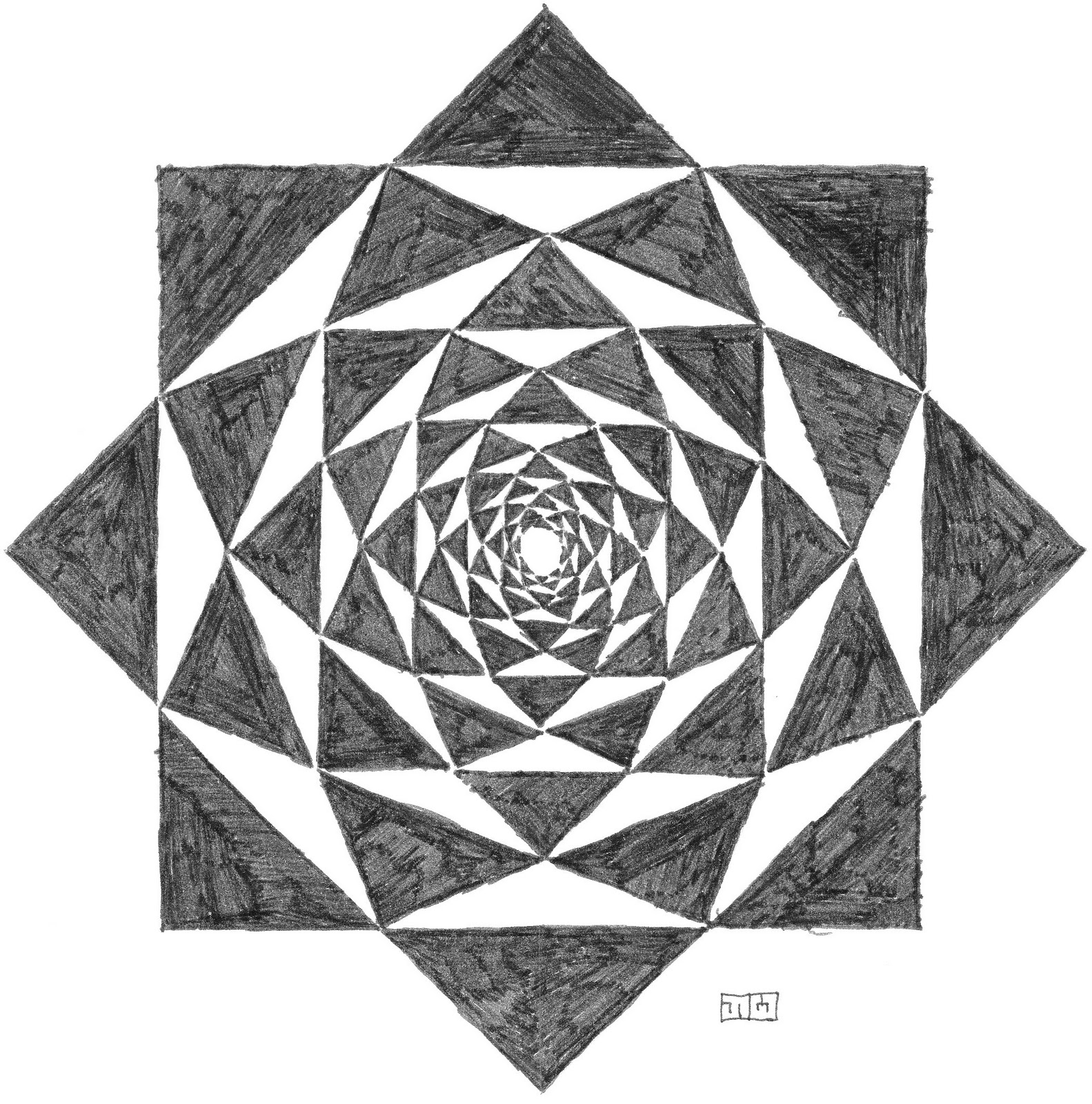
First tessellation, 2003

Nine-sided knot tessellation, 2003

Continuation of a triangle into a tessellation, 2003

Attempt at a color wheel without the necessary colors, 2004

Graph for dodecagonal tessellations, 2004

Tongue-wagger, 2004

Pretty Lady, 2004

Cartoon Dancer, 2006

Graph for three-sided knot puzzle piece tessellation, 2006

Graph for three-sided chessboard and tessellations, 2006

Knot tessellation, 2006

Two-type knot tessellation, 2006

Knot tessellation in matrix, 2006
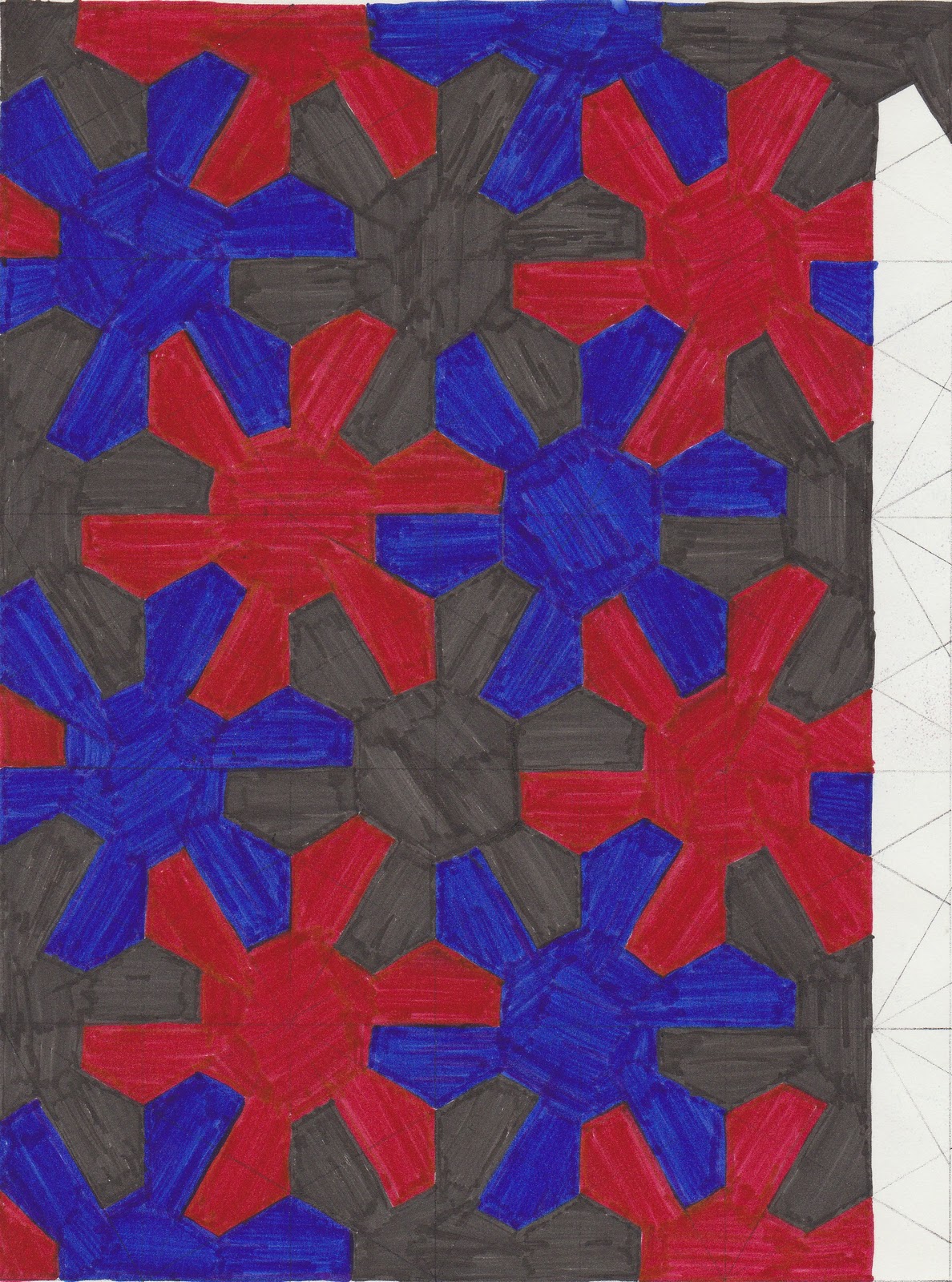
Tessellation, 2006

Dichrome study, 2006

Triangle tessellation graph, 2005

Clashing colors, 2000

Mountains tessellation, 2006

Claw tessellation, 2006

Dove tessellation origin, 2006

Conception of a repeating block print tessellation, 2005

Missing pieces, 2002
Subscribe to:
Posts (Atom)
